

Canadian researchers have identified the remains of an ornithomimosaur in marine sediments on a small Canadian island. This giant dinosaur could lead paleontologists to a better understanding of the distribution of its kin in this corner of the world.
On the small island of Denman, located off the coast of British Columbia, paleontologists have just discovered a caudal vertebra—nearly 80 million years old—embedded in sedimentary rock. And it didn’t belong to just anyone! In the journal Facets, Victoria M. Arbour, Timon S. Bullard, and David C. Evans reveal that this bone belongs to an ornithomimosaur—a theropod (two-legged) dinosaur known for its speed and a morphology closely resembling that of our modern-day ostrich.
For the first time, this fossil provides proof that these “bird-mimic lizards”—the literal translation of their Latin name—once roamed the Pacific coasts of North America during the Cretaceous period.
Brought to Light After More Than Two Decades
Although these dinosaurs belonged to the theropod family—the same family as some of the era’s largest predators (such as Tyrannosaurus and Velociraptor)—their appearance was vastly different from that of their sharp-toothed cousins. However, they possessed two long, feathered legs, an equally feathered long neck, a toothless beak, and a slender body—features the researchers have depicted as being covered in feathers. Some species, such as Gallimimus or Ornithomimus, could exceed 7 meters in length. Moreover, scientists believe they were omnivorous and ranked among the fastest dinosaurs of their time. Their estimated top speed was 60 kilometers per hour.
The fossil under study consists of a tail vertebra from a specimen that lived during the Late Cretaceous period, approximately 75 to 80 million years ago. This treasure was discovered in August 1999 within marine sediments that formed in the area of the present-day Cedar District—on Denman Island in western Canada—before subsequently falling into obscurity.
A Carcass That May Have Floated There?
Paleontologist David Evans and his team point out that this represents, to date, the “second known example of a dinosaur fossil found in the Nanaimo region”—and, more importantly, the first to be recovered from Canadian rock outcrops in the area. But how did the bone of this terrestrial animal end up lodged in such a spot? The report’s authors suggest that the carcass of this ornithomimosaur may have been swept away by the sea or scavengers. It may have disarticulated offshore.
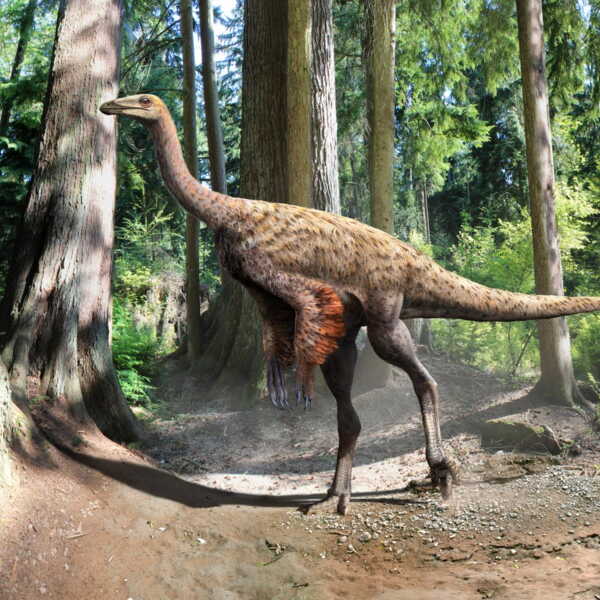
According to them, this dinosaur “probably” lived on the western flank of ancient North America, at a latitude comparable to that of other regions on the eastern side of the continent—areas known to have supported a rich fauna. On the Pacific coast, traces of dinosaur activity remain extremely rare. However, this does not mean that they did not inhabit the region. Paleontologists are convinced that the mountain ranges in this zone isolated certain populations for millions of years.