

Why did T. rex have tiny arms?
Scientists may have finally solved the riddle of Tyrannosaurus rex’s small arms. These arms have always stood out as the oddest feature in the mightiest of dinosaurs and are frequently discussed in context with Tyrannosaurus tiny arms fossil dinosaur discoveries. As a result, they have prompted jokes and a century-plus debate on their purpose and evolutionary history.
At about 3 feet long, the arms of T. rex were less than a third of the length of the dinosaur’s legs. Notably, they looked disproportionate in a body that could span more than 40 feet in larger adults. Interestingly, many Tyrannosaurus tiny arms fossil dinosaur specimens show this dramatic size contrast.
T. rex was one of many meat-eating dinosaurs with puny arms. Over the years, scientists have come up with theories for the forelimbs’ function, including holding or pinning down prey and impressing potential mates during courtship. More recent studies have suggested that the arms became smaller to reduce the risk of being bitten during feeding frenzies. Meanwhile, a longstanding theory is that they are simply vestigial — they had no practical purpose and therefore shrank. But a consensus is lacking. Therefore, the Tyrannosaurus tiny arms fossil dinosaur question still intrigues paleontologists today.
Now, a new study published May 20 in the journal Proceedings of the Royal Society B aims to settle the debate once and for all. The study analyzed 85 species of dinosaurs and concluded that tiny arms were an evolutionary trade-off. In particular, another body part became ever larger and took up resources — the skull.
“If you’re a dinosaur with a very strongly put together skull, chances are you’re going to have very small forelimbs,” said Charlie Roger Scherer, a doctoral student in the department of Earth sciences at University College London and the study’s lead author. “And it doesn’t really matter how big you are — you could be 1 ton in weight, or 10 tons in weight. If you have a strong skull, you’re going to have relatively small arms.” As a result, the Tyrannosaurus tiny arms fossil dinosaur mystery is closely connected to skull strength and functionality.
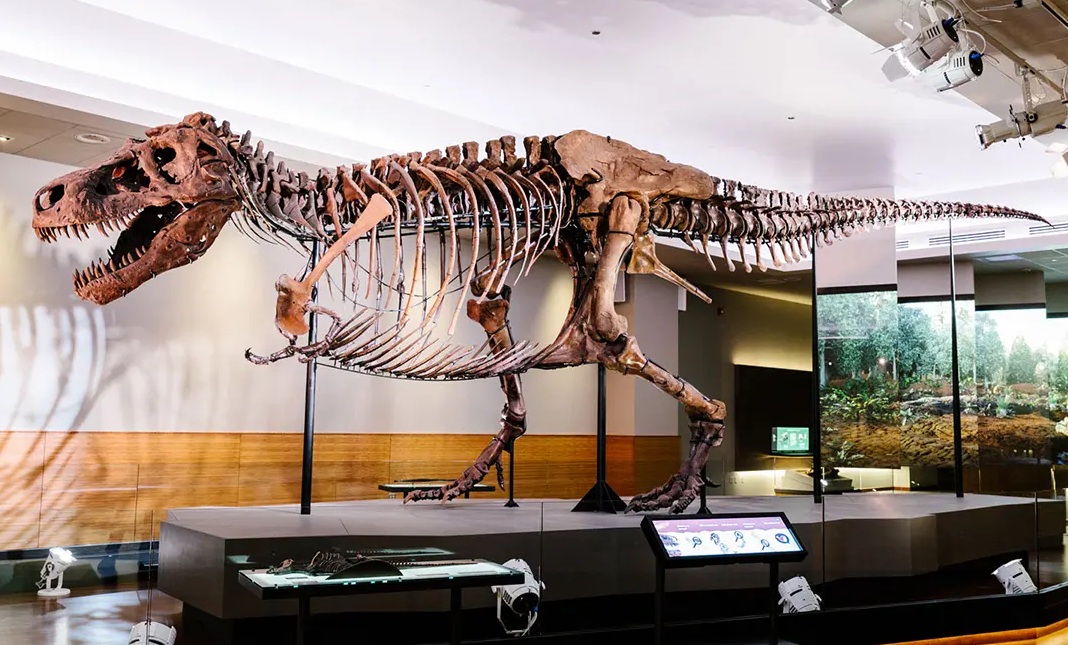
The reason is that “evolution doesn’t like to have everything all at once,” as Scherer put it, because it tends to prioritize one thing over another. “If you want to focus on using your head to bring down large prey, you don’t really want to be putting much effort in keeping your arms long and with claws, because you’re probably not really going to need that, so evolution kind of says, ‘We don’t need the arms anymore, so let’s shrink them down and put more energy into keeping the skull strong and using that as the primary weapon.’”
Previous research already suggested a link between shrinking forelimbs and growing skulls in carnivorous dinosaurs. However, the new study is the first, according to Scherer, to identify this trend in five different groups of dinosaurs and add statistical support to the theory.